
Lab Verification
A Certificate You Cannot Verify Is Just A PDF. Anyone Can Make A PDF.
A certificate only proves something if the lab that issued it will confirm it. Most buyers see a lab logo, a green "pass" and a percentage, and stop there. Here is the one detail that separates a real record from a nice looking file.
 Visit AKRO Research →
Every supplier in this space has a certificate. Every certificate has a lab name, a percentage and the word "pass". They all look the same.
That is the problem. A certificate is a document. Documents are easy to make, easy to edit and easy to reuse. A logo costs nothing to paste.
So the question is never "is there a certificate?" The question is "can I check it with someone who is not the seller?"
AKRO Research certificates carry a code you check with the lab, not the store.
Each published record names the testing lab, its website and a verification code for that report. The original PDF opens from the product page.
Claim Buy 1, Get 1 →1A lab name is not a lab confirmation
Putting a lab's name on a page costs nothing. It does not mean the lab tested that lot, or any lot, or that the numbers match what the lab actually sent.
Think of a reference on a CV. Listing a name proves nothing. Calling the number does.
A name on the page is a claim. A code the lab will confirm is proof.
2What a verification code actually does
A real testing lab issues each report its own reference number. Take that number to the lab, and the lab tells you whether the report exists and what it says.
If the seller changed a number, reused an old report or invented one, it falls apart right there. The seller is out of the loop.
Verification only counts when the seller cannot answer for the lab.
 Visit AKRO Research →
3Accreditation is the lab being checked too
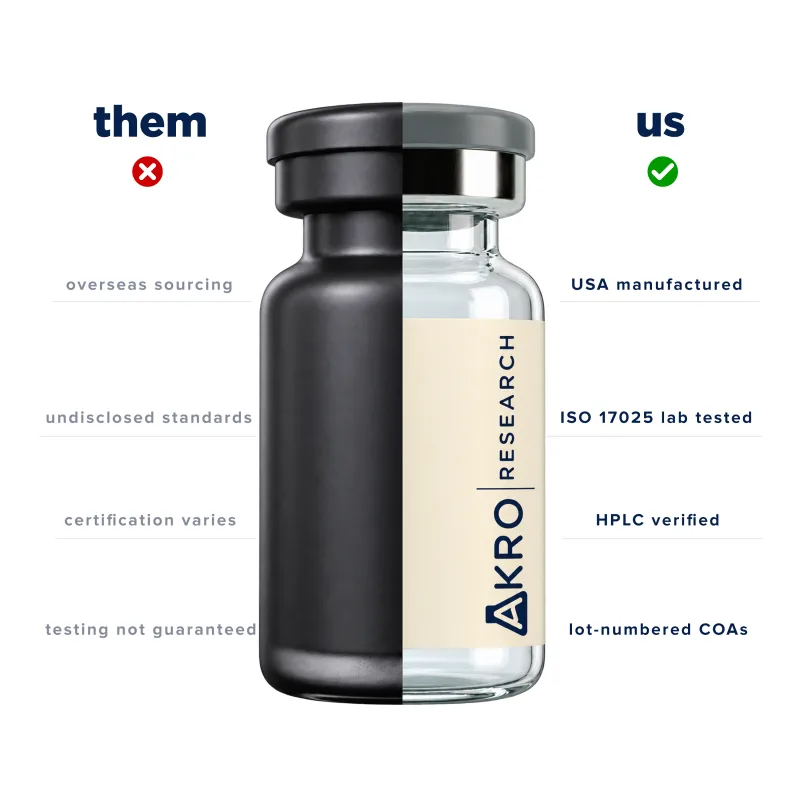
Some labs run tests. Accredited labs run tests and get audited on how they run them. ISO/IEC 17025 is the international standard for exactly that: testing competence, checked by an outside body.
It does not make every result perfect. It means the lab's methods are held to a standard someone else enforces.
A tested product is good. A product tested by a lab that is itself audited is better.
Layout summarised from a published AKRO lot record. Accreditation and fields depend on the lab named on each record.
4Screenshots are where proof goes to die
A cropped image of a certificate on a product page tells you even less than a PDF. No reference number. No way to check it. Often no lot number either.
If a supplier will only show you a picture of a document, ask for the document. If they cannot give it to you, that is your answer.
If you cannot open the original, you cannot check the original.
5The sixty second check
- A named lab with a real website. Not just a logo.
- A report or verification code. Something the lab can look up.
- The original PDF. Not a screenshot, not a summary.
- A lot number and test date. So you know which material it covers.
If one of the four is missing, the certificate is decoration.
| On the certificate | AKRO Research | Typical listing |
|---|---|---|
| Testing lab named | Yes, with website | Sometimes |
| Verification code | On the record | Rarely |
| Original PDF | Opens from the product page | Screenshot or on request |
| Lot and test date | Printed | Often missing |
| Accredited lab | ISO/IEC 17025 on records that say so | Rarely stated |
Do not trust the PDF. Check it.
Open the record, take the code to the lab named on it, and see for yourself. Buy 1, Get 1 Free is live on AKRO Research now.
Claim Buy 1, Get 1 →
Comments
The CV reference comparison is exactly it. I never once called the number.
Went looking for a code on my last supplier's certificate. There was a logo and a percentage. That was it.
Took the code off the record to the lab's site. Same numbers. Took two minutes.
Never knew labs themselves get audited. That changes how I read the lab name.
Screenshot of a certificate on the product page. That is all I had been getting. Not anymore.